
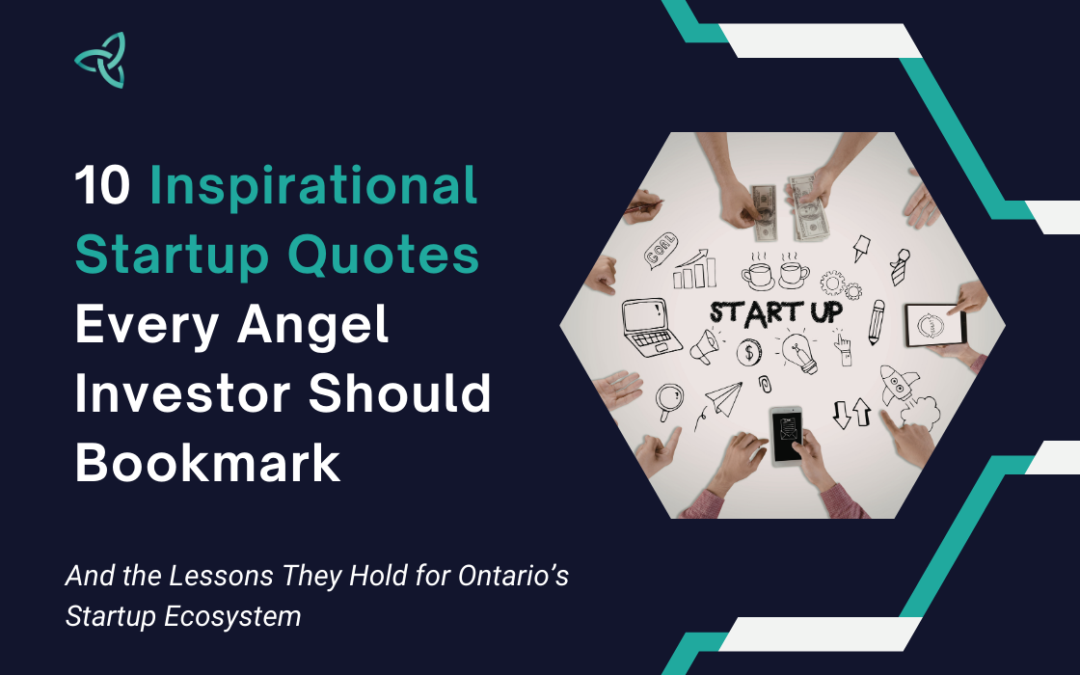
As angel investors, we aren’t just providing capital — we’re betting on people, timing, and potential. But what separates the good investments from the great ones? Often, it’s less about the pitch and more about the execution, mindset, and team dynamics behind it.
Below are ten inspirational and instructive quotes from some of the world’s top founders, investors, and startup operators — paired with real-world lessons that every Ontario angel and entrepreneur should remember. Whether you’re sitting on a diligence call or mentoring a new founder, these are the truths that hold up time and again.
“If you’re not embarrassed by the first version of your product, you’ve launched too late.”
— Reid Hoffman, Co-founder, LinkedIn
Lesson: Many founders believe they need a polished product before going to market or to investors. But what angels really want to see is validation through action, not hypotheticals.
Investor Tip: Push founders to launch early and test. Speed to feedback is more valuable than perfection.
“I always advise startups to raise smart money, not just money.”
— Mark Cuban, Investor, Shark Tank
Lesson: Founders often chase valuation or big-name backers without considering what value-add the investor brings.
Investor Tip: As angels, highlight your sector knowledge, networks, and mentorship value. And watch for founders who understand the difference — it’s a sign of long-term maturity.
“The team you build is the company you build.”
— Vinod Khosla, Founder, Khosla Ventures
Lesson: The first few hires are critical. A brilliant founder surrounded by the wrong team can still fail.
Investor Tip: Look for a marketing and sales lead early — too many pitches lack go-to-market thinking. And beware the “CTO-only” founding teams with no customer path.
“Coachable founders are fundable founders.”
— Paul Graham, Co-founder, Y Combinator
Lesson: Passion is necessary, but humility and learning agility matter more over time. A coachable founder can iterate fast and win.
Investor Tip: In first meetings, gently challenge the founder’s assumptions. A defensive reaction may signal trouble. A thoughtful response? A green light.
“The best startups always have the most up-to-date view of their competition.”
— Ben Horowitz, Co-founder, Andreessen Horowitz
Lesson: If a founder says “we have no competition,” run. Markets move fast, and blind spots kill companies.
Investor Tip: Ask how often the competitive landscape is updated. Monthly? Quarterly? Good teams track competitors like hawks — and pivot when needed.
“When you’re early, your IP may be the only real asset you own.”
— Ann Miura-Ko, Partner, Floodgate
Lesson: Intellectual property won’t stop a bad actor, but it does signal credibility and value — especially in sectors like life sciences, cleantech, and AI.
Investor Tip: Even if they can’t afford to defend a breach, startups with patents or defensible IP can still attract strategic buyers. No IP? The exit value often drops significantly.
“You can learn more about a founder in 30 minutes of due diligence than in 3 hours of pitching.”
— Naval Ravikant, AngelList Co-founder
Lesson: The pitch is just the beginning. Real insights surface in how founders answer follow-ups, share data, or explain inconsistencies.
Investor Tip: Before you even meet the founder, review their deck, cap table, and online presence. You’ll often spot misalignments before the first call.
“Trust, but verify — and ask for shareholder reporting rights.”
— Brad Feld, Co-founder, Foundry Group
Lesson: Angels often trust too much post-close. But regular updates, even informal ones, are essential to track progress and course-correct.
Investor Tip: Include reporting expectations in your term sheet — even quarterly updates or OKRs. It helps founders stay transparent and you stay informed.
“Sometimes, the product is great — but the founder can’t tell the story.”
— Brian Chesky, Co-founder, Airbnb
Lesson: Founders often underestimate the power of storytelling. A great product needs a great narrative to raise money, hire talent, and convert customers.
Investor Tip: If the pitch is technically sound but hard to follow, offer coaching or connect the founder to a communications advisor or pitch coach. A compelling story can change everything.
“Your startup is defined by what you say ‘no’ to.”
— Steve Jobs, Co-founder, Apple
Lesson: Focus is everything. Founders who chase too many features, customers, or partnerships early on usually burn out.
Investor Tip: Look for signs that a startup is focused and disciplined — especially in use-of-funds, product roadmap, and target market. Strategic simplicity is a competitive advantage.
🧭 Final Thought: Quotes Are Memorable — But Execution Wins
Inspirational quotes are powerful because they distill decades of hard-won wisdom into a single, memorable line. But in angel investing, words must translate into discipline — in diligence, mentoring, and post-investment support.
As Ontario’s angel community continues to evolve, we encourage investors to share these insights with founders — not just as encouragement, but as guideposts.
And for entrepreneurs: let this list be a reminder that every investor has seen dozens of pitch decks. The ones that get funded show not just passion — but pattern recognition, preparation, and persistence.
📖 Want more insights like this? Read real Ontario success stories in our flagship publication:
FUNDED – by Angel Investors Ontario
Discover why every visitor spends an average of 9.25 minutes per visit. Chances are, you’ll walk away with more than just inspiration — you’ll find your next idea, partner, or path forward.
Non-Disclosures (NDAs), Minefield or Just a Minor Document? A Field Guide for Angel Investors, Entrepreneurs and Business Advisory
Over many years of working with, or considering working with, many companies both minor and major, I have encountered a plethora of NDAs landing on my laptop, with the sender’s annotation that please sign this NDA, it’s just a standard form document. However, I have...
Competing on the World Stage: What Angels, Entrepreneurs, and Olympians Have in Common
As we watch the world’s greatest athletes compete on the Olympic stage this summer, it’s hard not to draw parallels between elite sport and the world of entrepreneurship and early-stage investing. The athletes we admire are not simply gifted — they are disciplined,...
Fourteen Things We Can Improve in 2026 — Reflections for Angel Investors and Innovation Entrepreneurs in Ontario
Introduction: A Year That Demanded Honesty 2025 was one of those years that forced honesty on Ontario’s innovation ecosystem. After attending dozens of angel meetings, pitch events, incubator demos, accelerator showcases, policy roundtables, and investor forums —...

Wait… Who Owns Our Data? Why the US May Access Information Stored on Canadian Soil — and What We Should Do About It.
I’m confused — and I suspect I’m not alone. Can the U.S. government force a U.S. corporation to provide access to data stored in a foreign country — say, a Canadian company’s data sitting on a server in Toronto — simply because the data centre is owned by a...
Building Canada Strong — and How AIO Plays Its Part
Canada’s new federal Budget sets out a bold agenda: making capital investments a national priority, building resilience against global shocks, and ensuring that Canadians are empowered with skills, opportunity, and a competitive economy. The document states that...
Broadening the Tent: Unlocking Early-Stage Capital through Smarter Investor Access. The US Passes Bill to let an Exam Determine if Investor is Accredited.
In today’s economy, startups are not just launching businesses—they’re launching the future. Yet one critical ingredient remains in short supply: early-stage risk capital. As angel investors and entrepreneurs across Ontario know all too well, the journey from ideation...